Vue Smart Glasses

PROJECT SNAPSHOT


Reimagining Smart Glasses as an AI Meeting Companion for Modern Professionals

As AI assistants become increasingly integrated into daily work, smart glasses need stronger use cases beyond music, notifications, and media controls. Vue Smart Glasses saw an opportunity to evolve from a wearable companion into an AI-powered productivity tool for professionals.

As part of a team of four designers, I helped design a new AI meeting assistant experience spanning smart glasses and mobile devices. Through user research, we uncovered pain points before, during, and after meetings, leading to four core features: Meeting Preparation, Real-Time Transcription, AI Meeting Assistant, and Meeting Summaries & Action Items.

Product Solution

01 — Meeting Preparation

  • Synced calendars, agendas, and recurring meeting notes in one place

  • Used AI to generate meeting briefs and preparation materials

02 — Capture Key Moments

  • Transcribed conversations in real time

  • Enabled gesture-based highlighting through smart glasses

  • Made important discussions easier to revisit later

03 — Meeting Summary & Action Items

  • Automatically organized discussions into structured summaries

  • Extracted action items and assigned ownership

  • Helped teams track progress after meetings

04 — AI Meeting Assistant

  • Available throughout the entire meeting lifecycle

  • Answered questions based on meeting history and transcripts

Vue Smart Glasses

PROJECT Overview


Reimagining Smart Glasses as an AI Meeting Companion for Modern Professionals

As AI assistants become increasingly integrated into daily work, smart glasses need stronger use cases beyond music, notifications, and media controls. Vue Smart Glasses saw an opportunity to evolve from a wearable companion into an AI-powered productivity tool for professionals.

As part of a team of four designers, I helped design a new AI meeting assistant experience spanning smart glasses and mobile devices. Through user research, we uncovered pain points before, during, and after meetings, leading to four core features: Meeting Preparation, Real-Time Transcription, AI Meeting Assistant, and Meeting Summaries & Action Items.

Product Solution

01 — Meeting Preparation

  • Synced calendars, agendas, and recurring meeting notes in one place

  • Used AI to generate meeting briefs and preparation materials

  • Synced calendars, agendas, and recurring meeting notes in one place

  • Used AI to generate meeting briefs and preparation materials

02 — Capture Key Moments

  • Transcribed conversations in real time

  • Enabled gesture-based highlighting through smart glasses

  • Made important discussions easier to revisit later

  • Transcribed conversations in real time

  • Enabled gesture-based highlighting through smart glasses

  • Made important discussions easier to revisit later

03 — Meeting Summary & Action Items

  • Automatically organized discussions into structured summaries

  • Extracted action items and assigned ownership

  • Helped teams track progress after meetings

  • Automatically organized discussions into structured summaries

  • Extracted action items and assigned ownership

  • Helped teams track progress after meetings

04 — AI Meeting Assistant

  • Available throughout the entire meeting lifecycle

  • Answered questions based on meeting history and transcripts

  • Available throughout the entire meeting lifecycle

  • Answered questions based on meeting history and transcripts

my Most memorable things

How might we transform smart glasses from a novelty device into an indispensable productivity tool for knowledge workers?

One of the most memorable challenges was designing how physical gestures could seamlessly work with AI, turning a simple tap on the glasses into a way to capture and organize important meeting moments. Working in a small startup environment also taught me how to balance technical constraints, business priorities, and rapid iteration to bring ideas to life quickly.


design IMPACT

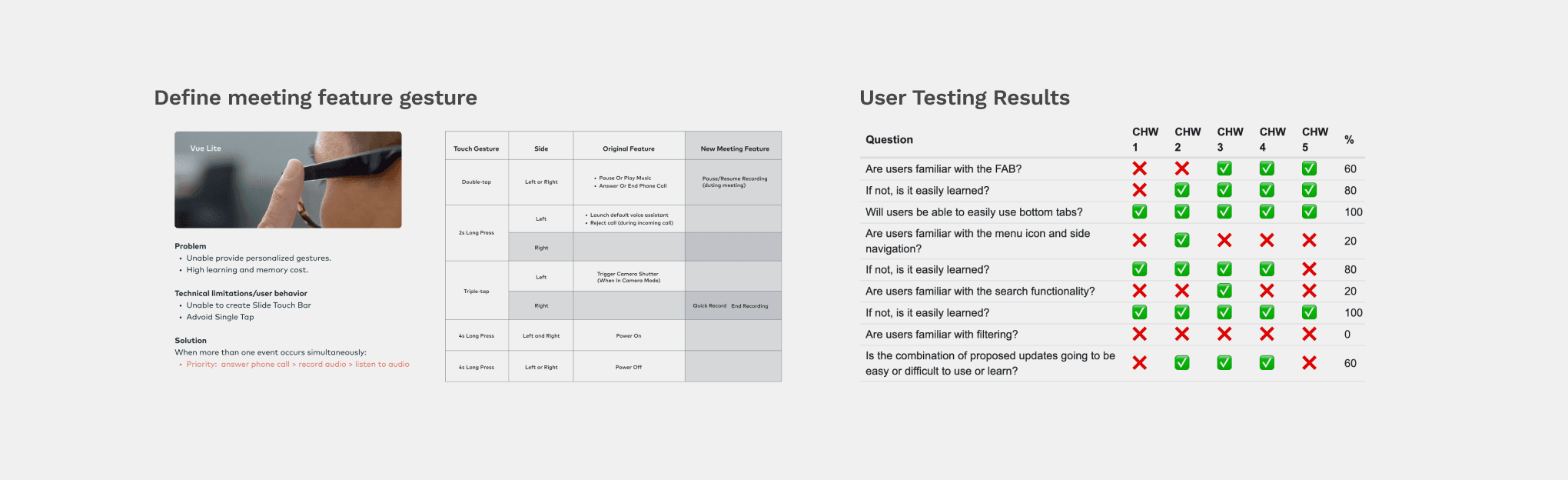
Tested with 10 frequent meeting participants. Users achieved a 100% task completion rate across key workflows, while 80% quickly learned gesture-based interactions and AI features with minimal guidance. 60% successfully adopted advanced workflows such as note organization and tagging, validating the usability of the proposed meeting experience.

my memorable things for this project

How might we transform smart glasses from a novelty device into an indispensable productivity tool for knowledge workers?

One of the most memorable challenges was designing how physical gestures could seamlessly work with AI, turning a simple tap on the glasses into a way to capture and organize important meeting moments. Working in a small startup environment also taught me how to balance technical constraints, business priorities, and rapid iteration to bring ideas to life quickly.


Tested with 10 frequent meeting participants. Users achieved a 100% task completion rate across key workflows, while 80% quickly learned gesture-based interactions and AI features with minimal guidance. 60% successfully adopted advanced workflows such as note organization and tagging, validating the usability of the proposed meeting experience.

Timeline

2024.04- 2024.06

ROLES

UX Designer

teams

4 Designers

tools

Figma, FigJam, Miro

Design Process

Understanding the Future of Wearable AI

Technology Strategy

Product Vision

Competitive Research

Evaluated the emerging landscape of AI hardware, wearable devices, and meeting productivity tools including Humane AI Pin, Rabbit R1, Otter, Zoom AI Companion, and other smart assistants. I also analyzed Vue's existing hardware capabilities and gesture system to identify opportunities that could be integrated into the current product ecosystem while supporting the company's long-term vision for professionals.

Mapped the Complete Meeting Journey Through 10 User Interviews

User Interviews

User Journey

Persona Development

We interviewed 10 frequent meeting participants and mapped their workflows across three stages: before, during, and after meetings. The research revealed that users struggled not only with note-taking during meetings, but also with preparation beforehand and organizing information afterward. These insights helped us define key opportunity areas and build personas that guided the product direction.

Defined an MVP That Balanced User Value and Technical Feasibility

Product Strategy

Feature Definition

Cross-functional Collaboration

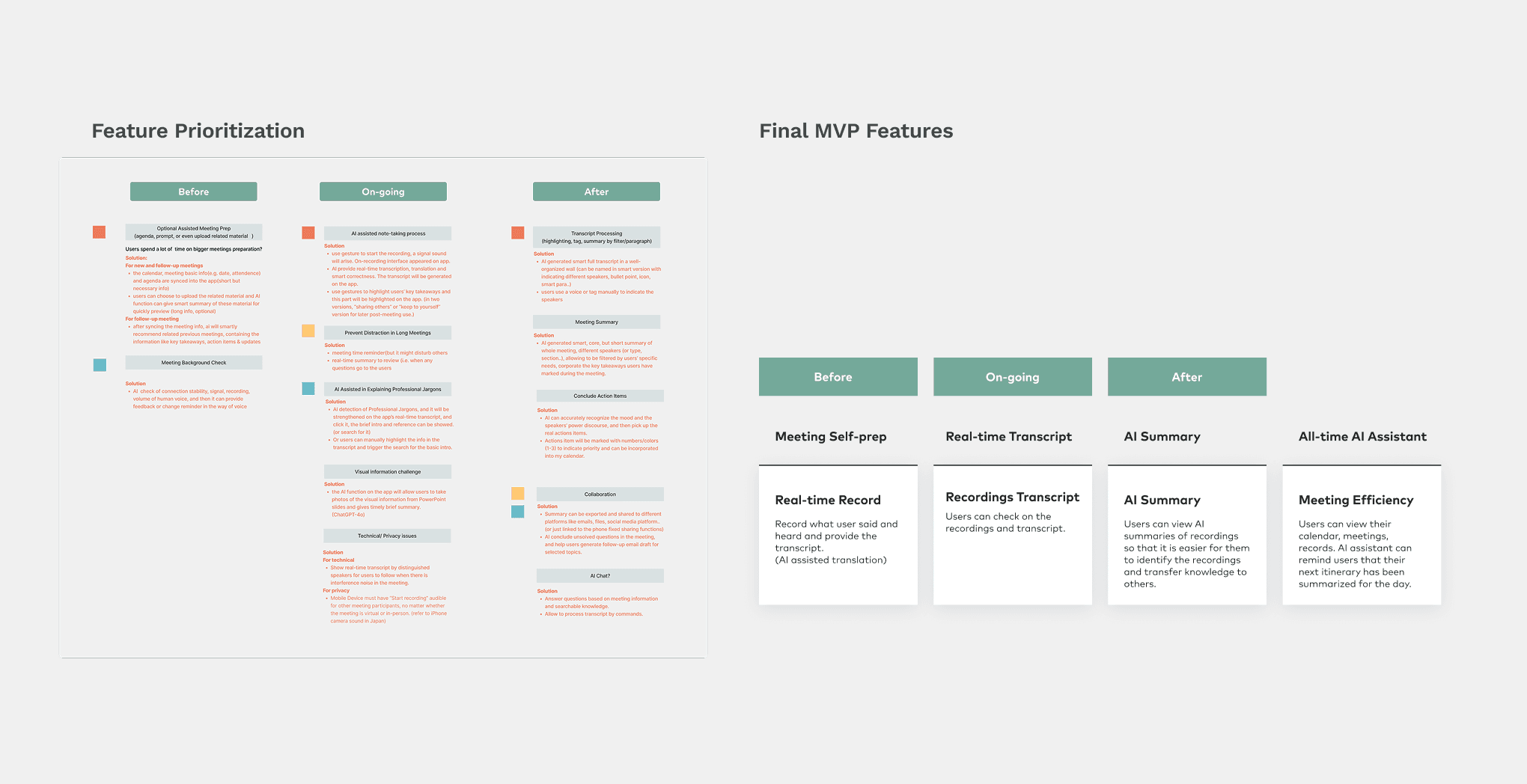
We generated more than 20 concepts across the meeting lifecycle and evaluated them against user needs, business goals, and technical feasibility. Through multiple reviews with designers and engineers, we refined the scope into four core features: Meeting Preparation, Real-time Transcript, AI Summary, and an Always-on AI Assistant, ensuring the solution could be both valuable and realistically implemented.
Built a New Information Architecture for an AI Meeting Experience

Information Architecture

User Flow Mapping

Interaction Design

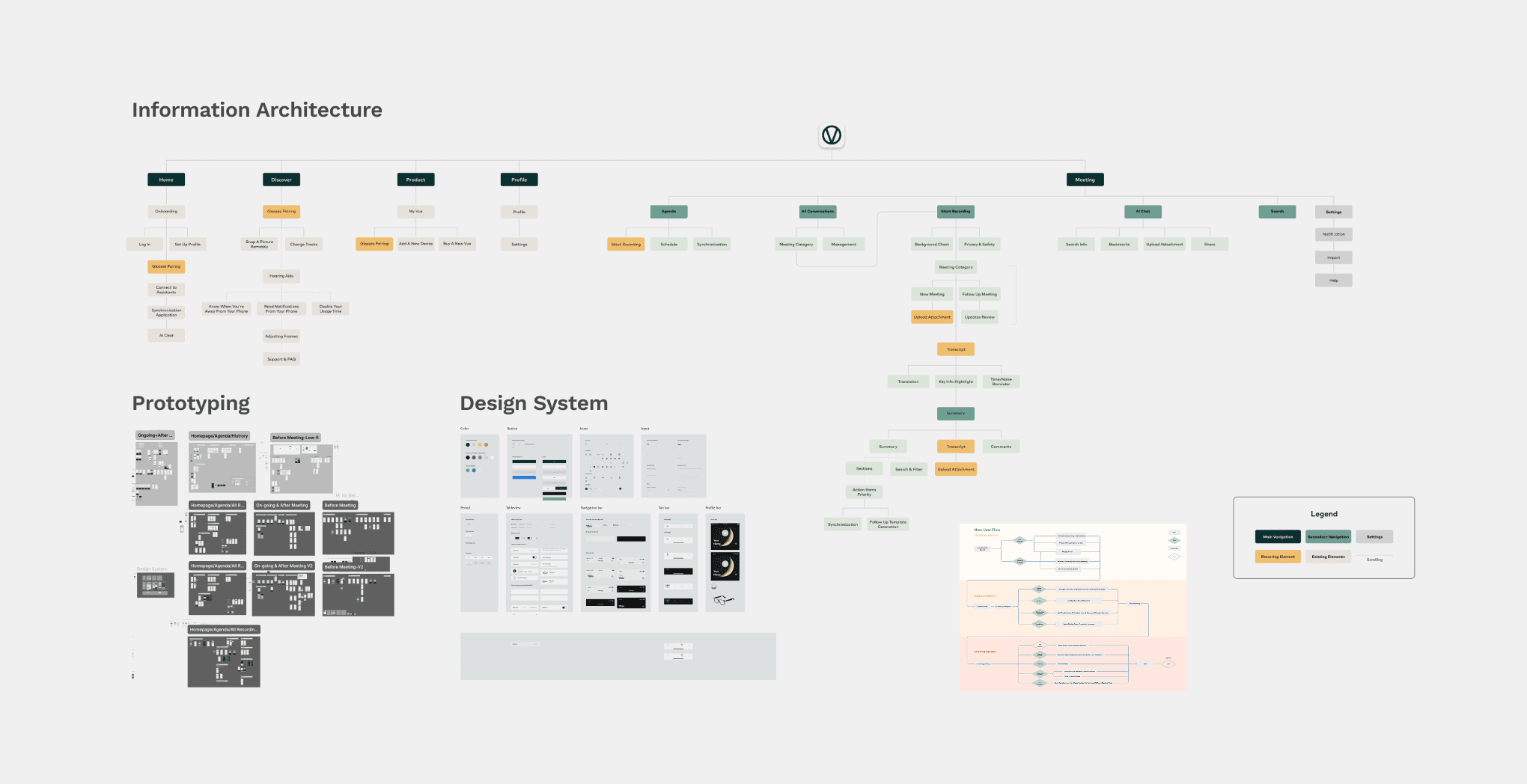
Because the AI meeting assistant was a completely new feature, we redesigned the information architecture and interaction model from the ground up. I created end-to-end user flows across before, during, and after meeting scenarios, while leveraging Vue's existing design system to ensure visual consistency and seamless integration with the current product ecosystem.
Learning & reflection

This project taught me how to shape product direction in situations where both the problem and solution were still ambiguous.

  • Defined the product scope and user scenarios through research when the initial PRD lacked concrete workflows and requirements.

  • Balanced innovation with feasibility by building on existing Alexa capabilities and smart-glasses interaction patterns.

  • Designed a cohesive experience across hardware and mobile touchpoints, ensuring users could move seamlessly between physical and digital interactions.

  • Defined the product scope and user scenarios through research when the initial PRD lacked concrete workflows and requirements.

  • Balanced innovation with feasibility by building on existing Alexa capabilities and smart-glasses interaction patterns.

  • Designed a cohesive experience across hardware and mobile touchpoints, ensuring users could move seamlessly between physical and digital interactions.