Trip.com

PROJECT SNAPSHOT


Making complex rail systems easier for international travelers to understand and navigate.

As Trip.com's rail business expanded across Asia, international travelers often struggled with fragmented information, unfamiliar rail systems, and complex local travel workflows.

During my Summer 2025 internship at Trip.com's International Rail team, I worked on multiple initiatives supporting international travelers across Asia rail networks. I led the design of JR Pass purchasing flows, post-booking travel guides, ticket redemption instructions, and onboard information experiences, while collaborating closely with PMs and engineers from discovery through launch.

Product Solution

01 — JR Pass Purchase Experience Helping travelers understand what they're buying before purchase.

  • Highlighted pass benefits before entering the detail page

  • Visualized redemption rules and usage guidance

  • Reduced steps through autofill and direct pass selection

02 — Station Travel Guide Guiding Travelers Beyond Ticket Purchase

  • Placed travel guidance where users naturally look after booking

  • Organized guidance by journey stage

  • Added station-specific instructions and tips

03 — Ticket Pickup Guidance Making Complex Redemption Flows Easier to Follow

  • Visualized redemption through annotated illustrations

  • Clarified ticket usage and gate entry rules

04 — Train Facilities & Carriage Information Provided visibility into onboard facilities before departure

  • Displayed carriage-specific amenities

  • Linked service information to purchased tickets

Trip.com

PROJECT Overview


Making complex rail systems easier for international travelers to understand and navigate.

As Trip.com's rail business expanded across Asia, international travelers often struggled with fragmented information, unfamiliar rail systems, and complex local travel workflows.

During my Summer 2025 internship at Trip.com's International Rail team, I worked on multiple initiatives supporting international travelers across Asia rail networks. I led the design of JR Pass purchasing flows, post-booking travel guides, ticket redemption instructions, and onboard information experiences, while collaborating closely with PMs and engineers from discovery through launch.

Product Solution

01 — JR Pass Purchase Experience Helping travelers understand what they're buying before purchase.

  • Highlighted pass benefits before entering the detail page

  • Visualized redemption rules and usage guidance

  • Reduced steps through autofill and direct pass selection

  • Highlighted pass benefits before entering the detail page

  • Visualized redemption rules and usage guidance

  • Reduced steps through autofill and direct pass selection

02 — Station Travel Guide Guiding Travelers Beyond Ticket Purchase

  • Placed travel guidance where users naturally look after booking

  • Organized guidance by journey stage

  • Added station-specific instructions and tips

  • Placed travel guidance where users naturally look after booking

  • Organized guidance by journey stage

  • Added station-specific instructions and tips

03 — Ticket Pickup Guidance Making Complex Redemption Flows Easier to Follow

  • Visualized redemption through annotated illustrations

  • Clarified ticket usage and gate entry rules

  • Visualized redemption through annotated illustrations

  • Clarified ticket usage and gate entry rules

04 — Train Facilities & Carriage Information Provided visibility into onboard facilities before departure

  • Displayed carriage-specific amenities

  • Linked service information to purchased tickets

  • Displayed carriage-specific amenities

  • Linked service information to purchased tickets

my Most memorable things

How might we help international travelers confidently navigate unfamiliar rail systems across Asia?

One of the most memorable parts of this internship was seeing how product decisions are made in the real world. I learned that great ideas are not only about creativity—they also need to align with technical constraints, business priorities, and release timelines. At the same time, working on international rail products showed me that localization goes far beyond translation. Understanding how travelers think, move, and navigate unfamiliar systems became just as important as designing the interface itself.

design IMPACT

I Delivered 10+ rail initiatives, proposed 4 product opportunities adopted into the roadmap, and contributed reusable CTA guidelines for future releases.

my memorable things for this project

How might we help international travelers confidently navigate unfamiliar rail systems across Asia?

One of the most memorable parts of this internship was seeing how product decisions are made in the real world. I learned that great ideas are not only about creativity—they also need to align with technical constraints, business priorities, and release timelines. At the same time, working on international rail products showed me that localization goes far beyond translation. Understanding how travelers think, move, and navigate unfamiliar systems became just as important as designing the interface itself.

I Delivered 10+ rail initiatives, proposed 4 product opportunities adopted into the roadmap, and contributed reusable CTA guidelines for future releases.

Timeline

2025.5-2025.8

ROLES

UX Design Intern

teams

International Rail Team

tools

Sketch, Figma, Feishu

Design Process

Building Domain Knowledge in a Rapidly Growing Business

Domain Research

Systems Thinking

Knowledge Management

To quickly ramp up in the growing Asia Rail business, I reviewed product documentation, historical design files, analytics reports, and existing design standards. Recognizing gaps in internal knowledge, I also conducted independent research on Asian rail systems, ticketing rules, and traveler workflows across Japan, China, and Hong Kong, creating structured references that helped inform future product and design decisions.
Identifying Product Opportunities Through Multi-Source Research

User Research

Competitive Analysis

Brainstorm

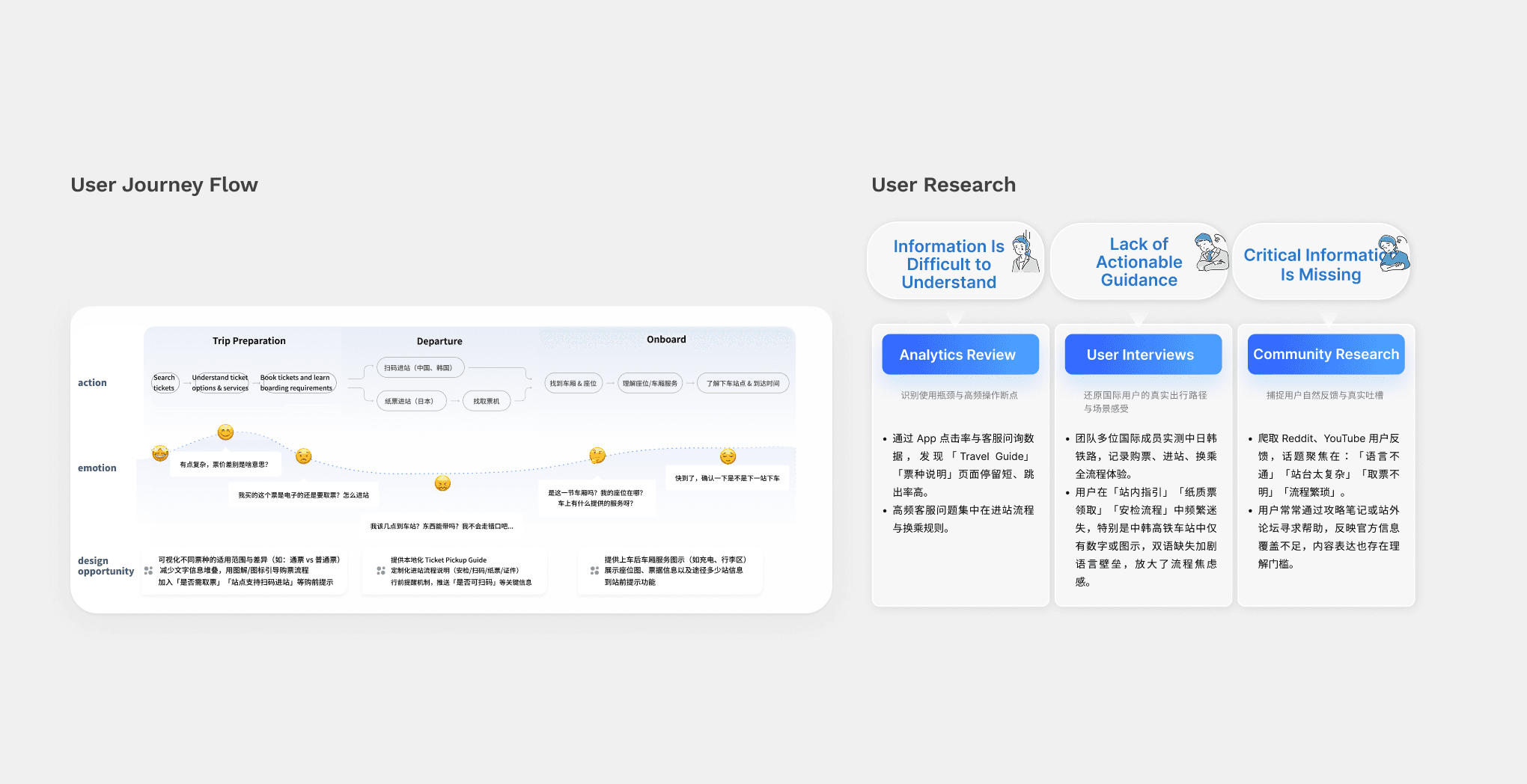
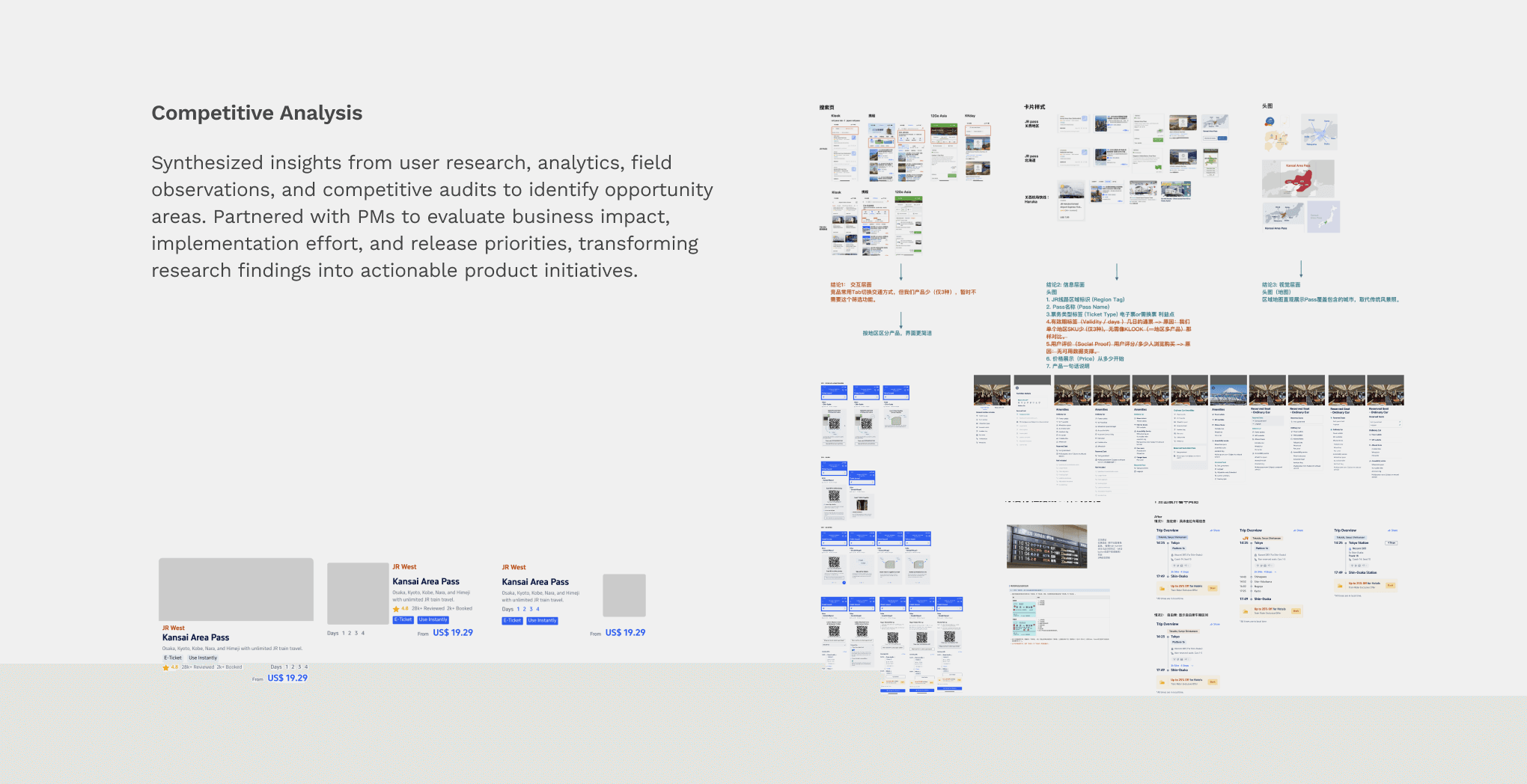
I combined platform analytics, customer feedback, field observations, and competitor audits across JR, 12306, Klook, and Amtrak to uncover recurring traveler pain points. These findings helped identify opportunities around ticket pickup, travel guidance, JR Pass onboarding, and onboard information transparency.

Driving Alignment Through Design Reviews & Cross-Functional Collaboration

Design Communication

Workshop Facilitation

Cross-Functional Collaboration

I regularly presented design proposals during internal design critiques and cross-functional reviews with PMs and engineers. Design reviews helped refine information architecture, localization patterns, and interaction details, while product and engineering discussions clarified business requirements, technical constraints, and implementation feasibility. Through these iterative conversations, I aligned user needs, business goals, and development priorities before finalizing solutions.
Ensuring Quality from Design to Launch

Design Delivery

Design QA

Localization Standard

After finalizing designs, I created detailed annotations, multilingual design specifications, and implementation guidelines to ensure consistency across markets. I collaborated closely with engineers during development, conducted QA reviews on staging builds, and defined tracking requirements to validate feature performance after launch.

Learning & reflection

I learned that successful international experiences depend on understanding business systems, cultural context, and information architecture

  • Quickly understanding business context is critical when entering a new domain

  • Localization extends beyond language to user expectations, cultural habits, and offline touchpoints

  • Clear information hierarchy and documentation can significantly reduce implementation complexity

  • Quickly understanding business context is critical when entering a new domain

  • Localization extends beyond language to user expectations, cultural habits, and offline touchpoints

  • Clear information hierarchy and documentation can significantly reduce implementation complexity