Piece

PROJECT SNAPSHOT


Helping newcomers navigate cities through people, not just information.

Every year, millions of students arrive in new cities, often relying on fragmented information scattered across guides, forums, and social platforms.

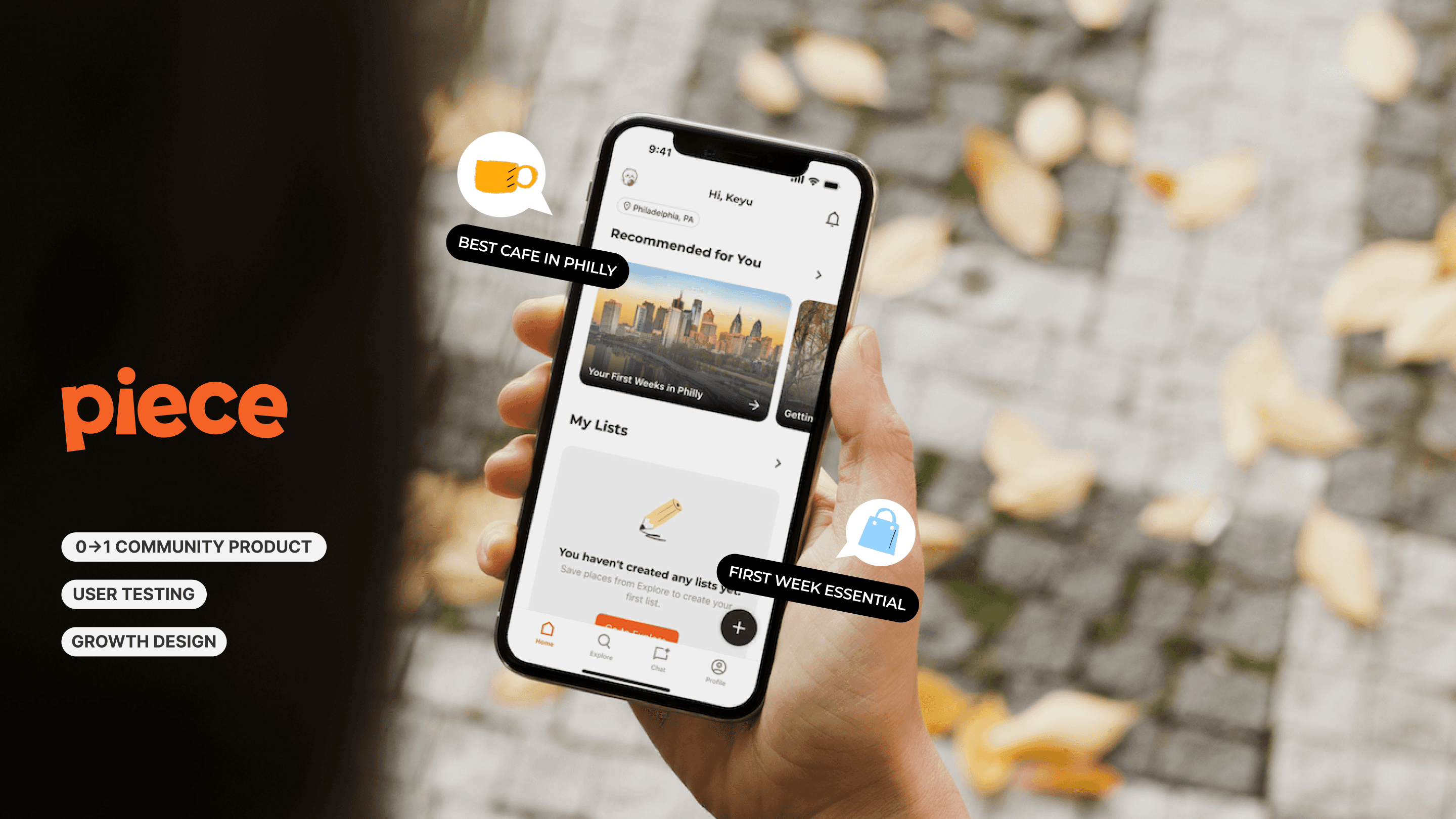
Piece is a social onboarding platform that uses curated Lists and location-based Postcards to help international students explore, belong, and connect in a new city.

Product Solution

01 — Curated Lists Instead of starting from scratch, you begin with curated, well-worn paths.

  • From official and trusted sources

  • Real notes, tips, and context for each place

  • Copy, tweak, and make it your own

02 — Personal Lists You use Lists to build your own understanding of the city

  • Set lists as public or private

  • Bring scattered places into your own topics

  • Save places and organize them seamlessly

  • Add personal notes and customize your lists

03 — Postcards Small moments turn into discoveries.

  • Capture moments tied to real locations

  • Turn moments into shareable postcards

  • Send to yourself, friends, or even strangers

04 — Social Discovery Connections grow through shared experiences.

  • Build familiarity through exchanges

  • After 3 interactions, get a connection suggestion

  • Connect with nearby or like-minded people

Piece

PROJECT Overview


Helping newcomers navigate cities through people, not just information.

Every year, millions of students arrive in new cities, often relying on fragmented information scattered across guides, forums, and social platforms.

Piece is a social onboarding platform that uses curated Lists and location-based Postcards to help international students explore, belong, and connect in a new city.

Product Solution

01 — Curated Lists Instead of starting from scratch, you begin with curated, well-worn paths.

  • From official and trusted sources

  • Real notes, tips, and context for each place

  • Copy, tweak, and make it your own

  • From official and trusted sources

  • Real notes, tips, and context for each place

  • Copy, tweak, and make it your own

02 — Personal Lists You use Lists to build your own understanding of the city

  • Set lists as public or private

  • Bring scattered places into your own topics

  • Save places and organize them seamlessly

  • Add personal notes and customize your lists

  • Set lists as public or private

  • Bring scattered places into your own topics

  • Save places and organize them seamlessly

  • Add personal notes and customize your lists

03 — Postcards Small moments turn into discoveries.

  • Capture moments tied to real locations

  • Turn moments into shareable postcards

  • Send to yourself, friends, or even strangers

  • Capture moments tied to real locations

  • Turn moments into shareable postcards

  • Send to yourself, friends, or even strangers

04 — Social Discovery Connections grow through shared experiences.

  • Build familiarity through exchanges

  • After 3 interactions, get a connection suggestion

  • Connect with nearby or like-minded people

  • Build familiarity through exchanges

  • After 3 interactions, get a connection suggestion

  • Connect with nearby or like-minded people

my Most memorable things

How might we help international students turn fragmented experiences into something that builds belonging?

More than a design project, Piece was an exercise in turning ambiguity into action—combining real-world research, AI-powered iteration, and cross-functional collaboration to transform an idea into a product people could actually use.


design IMPACT

Validated a community-driven onboarding experience through a TestFlight MVP, 30+ community-generated seed lists, and three rounds of testing with 20+ international students.

my memorable things for this project

How might we help international students turn fragmented experiences into something that builds belonging?

More than a design project, Piece was an exercise in turning ambiguity into action—combining real-world research, AI-powered iteration, and cross-functional collaboration to transform an idea into a product people could actually use.


Validated a community-driven onboarding experience through a TestFlight MVP, 30+ community-generated seed lists, and three rounds of testing with 20+ international students.

Timeline

2025.9-2026.4

ROLES

Founding UX designer

teams

3 designer, 3 Engineer

tools

Figma, Claude, Lovable, Cursor

Design Process

Newcomers were overwhelmed by scattered information across platforms.

User Research

Field Studies

COMPETITIVE ANALYSIS

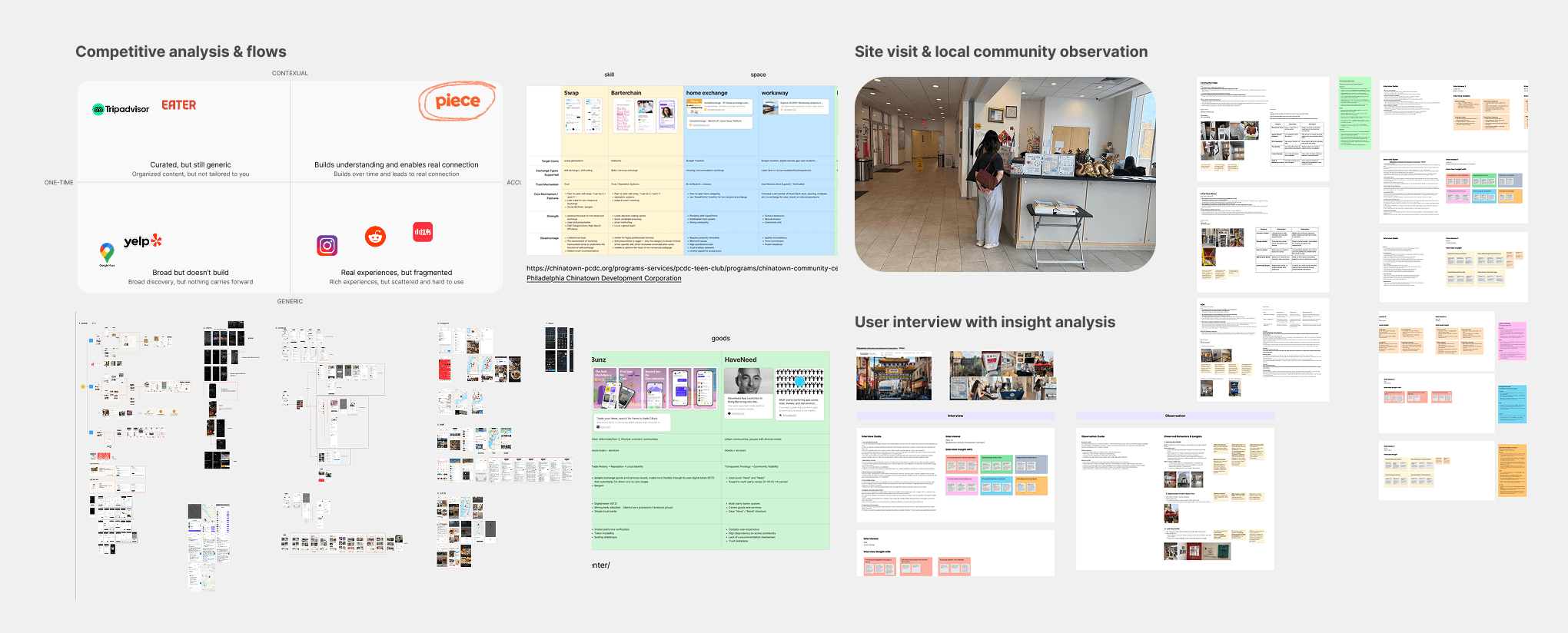
International students weren't lacking information—they were overwhelmed by it. Through 20+ interviews, 30+ surveys, site visits, and competitive analysis, we found that students relied on fragmented sources such as PDFs, group chats, social media, and map platforms to navigate a new city. The onboarding experience was scattered, difficult to trust, and hard to act on. Because international students showed both the strongest onboarding needs and the highest adoption of digital tools, they became the focus of our MVP.
We identified how onboarding needs evolve over time and tested multiple product directions before committing to an MVP.

INSIGHT SYNTHESIS

CONCEPT TESTING

AI PROTOTYPING

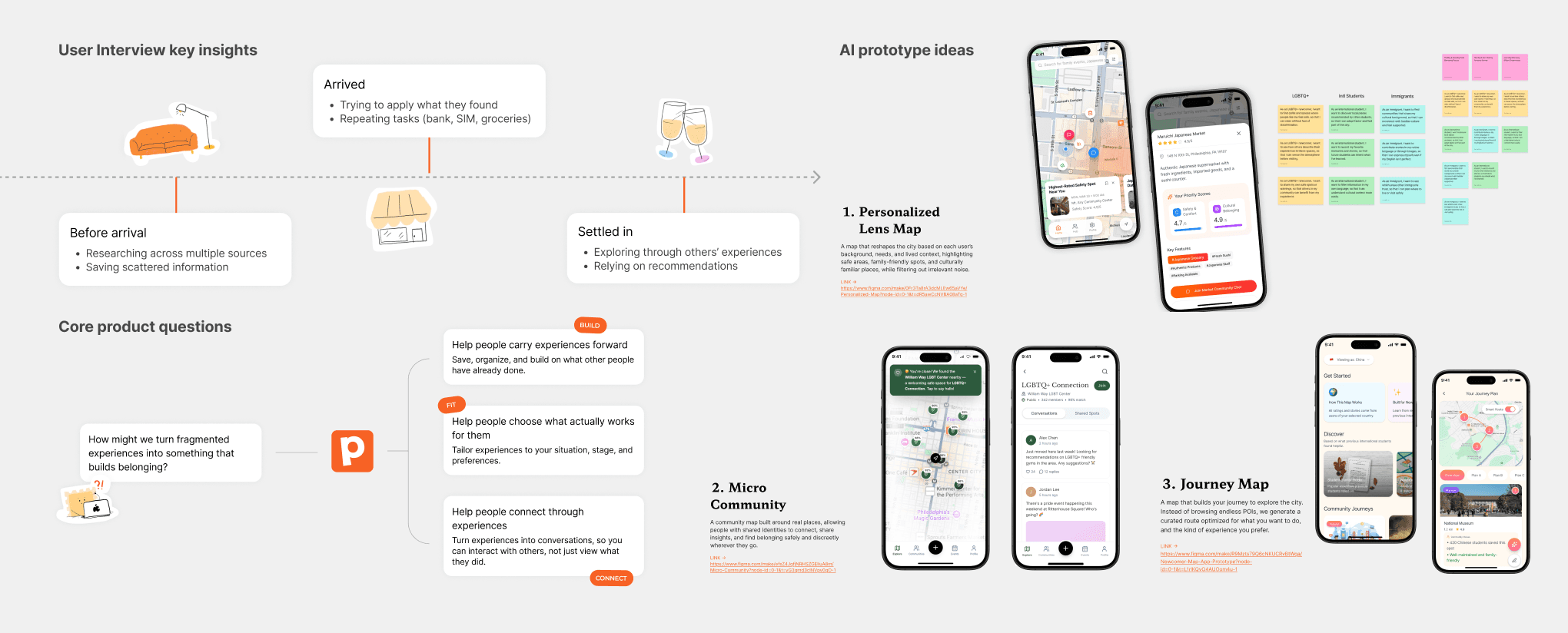
Through a second round of interviews with 15 international students, we mapped how needs evolve across different arrival stages—from information gathering before arrival, to practical settling-in tasks, to exploring the city after feeling established.

To explore solutions, our team generated 50+ ideas and synthesized them through affinity mapping into three concepts: Journey Map, Micro Community, and Personalized Lens Map. Using AI-assisted prototyping workflows, we rapidly built and tested all three directions with participants. More than two-thirds of participants preferred the map-based concept, leading us to focus the MVP around curated Lists and location-based discovery.
We built the product around two complementary experiences: Lists, which help newcomers navigate essential information, and Postcards, which encourage them to explore, document, and share meaningful moments in the city.

INFORMATION ARCHITECTURE

WIREFRAMING

DESIGN SYSTEMS

After defining the MVP direction, we mapped the product architecture across onboarding, discovery, list creation, postcards, and social interactions. We designed key user flows, structured the experience into 4 primary navigation areas, and established the information hierarchy. Based on this foundation, we built the visual identity, design system, color palette, typography, illustrations, and reusable UI components to create a consistent experience across the product.

We tested the experience, built the system, and explored how Piece could grow.

USABILITY TESTING

PRODUCT STRATEGY

MVP LAUNCH

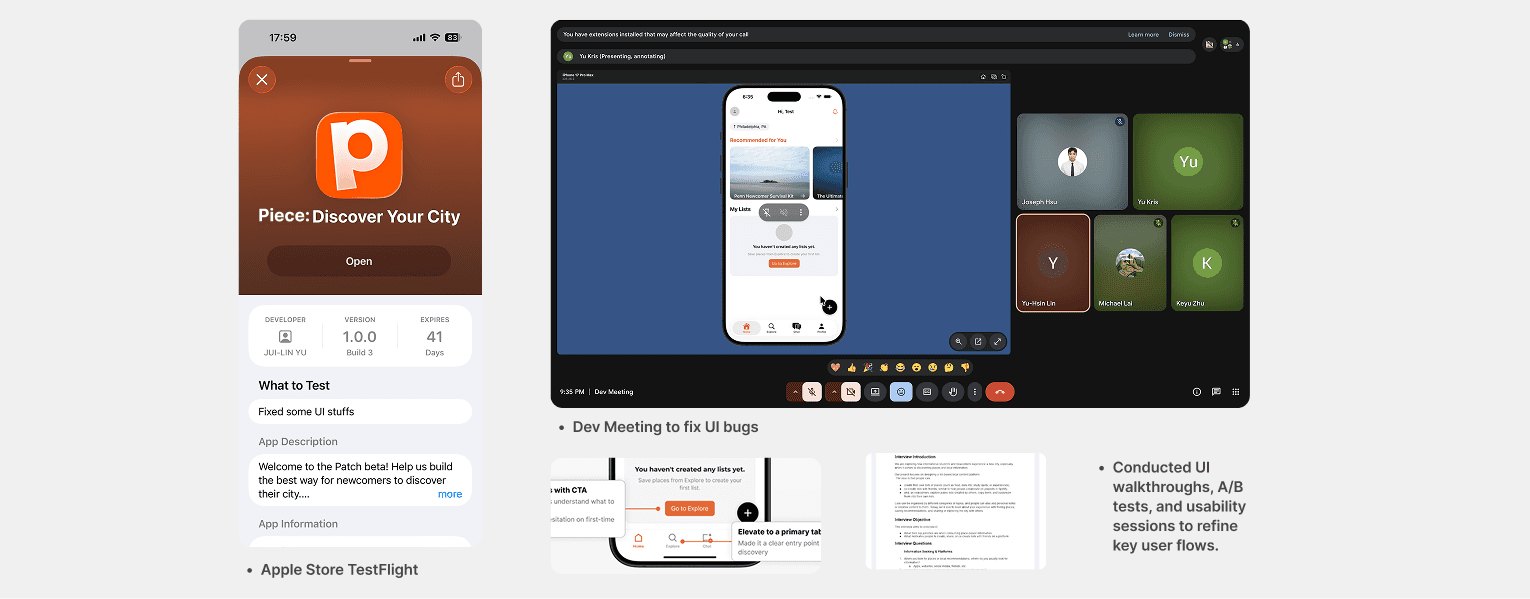
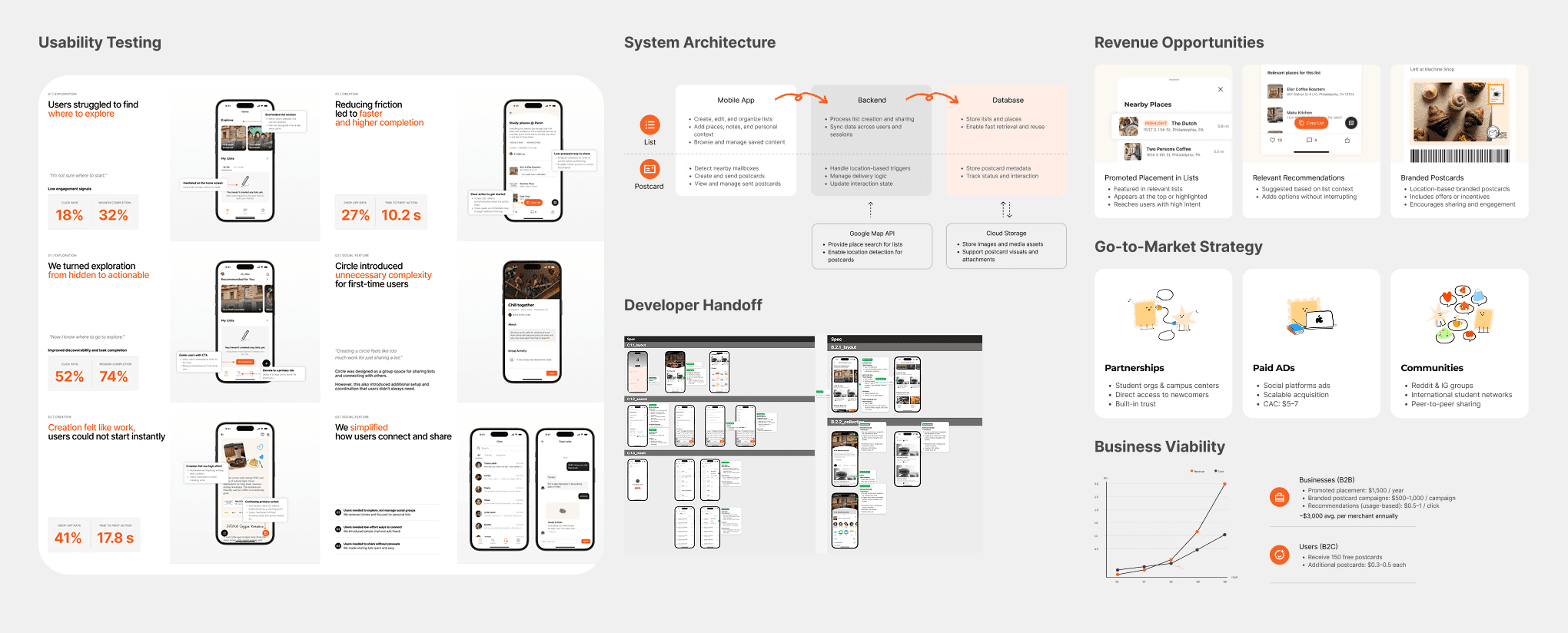
Through three rounds of usability testing with 30+ participants, we continuously refined the product by measuring click-through rates, task completion, drop-off rates, and time-to-first-action across key flows. Insights from testing led us to elevate Explore into a primary navigation tab, simplify list creation with reusable templates, and replace the Circle feature with lightweight chat interactions. Beyond the interface, we designed the backend architecture, collaborated with engineers on implementation, seeded the platform with 50+ curated onboarding lists, and explored monetization, growth, and partnership strategies to support long-term adoption.
Learning & reflection

I learned navigate ambiguity, leverage AI for rapid validation, and think beyond UX into product strategy and growth.

  • Turned uncertainty into direction by narrowing a broad problem space into a focused product opportunity.

  • Used AI to accelerate learning through rapid prototyping, concept validation, and iterative testing.

  • Approached design as a business problem by exploring go-to-market strategy, monetization, and sustainable growth models.

  • Turned uncertainty into direction by narrowing a broad problem space into a focused product opportunity.

  • Used AI to accelerate learning through rapid prototyping, concept validation, and iterative testing.

  • Approached design as a business problem by exploring go-to-market strategy, monetization, and sustainable growth models.